PUNJAB PUBLIC SERVICE COMMISSION Combined Competitive Examination (CCE) 2023 For Recruitment to the Posts of Provincial Management Service (PMS)
SUBJECT: Principle of Engineering (Paper-1) Time Allowed: 3 Hours Maximum Marks: 100
Note: Attempt any FIVE questions in all. Scientific calculator is allowed.
Instructions
Attempt any FIVE questions in all.
Calculator is allowed (not programmable).
Draw clear diagrams where necessary.
All parts must be attempted at one place instead of different pages.
Do not overwrite or cross answers.
Question 1
(a) What is the difference between wave mechanics and matrix mechanics? What is wave-particle duality? Why is the wave nature of matter not more apparent in everyday life?
(b) What do you understand by the term superconductivity? Discuss low temperature and high temperature superconductors and their applications. (10 + 10 = 20 Marks)
Question 2
(a) What are the effects of different crystalline structures of the same substance on its properties?
(b) Discuss in detail the heat capacity of solids and gases. What is the significance of the gas constant?
(c) Explain in detail:
Graham’s Law of Diffusion
Raoult’s Law
(2 + 2 + 6 = 20 Marks)
Question 3
(a) What do you understand by electromagnetic induction? How does Lenz’s Law help in determining the direction of induced current?
(b) What must be the magnitude of an isolated positive charge for the electric potential to be 120 V at 15 cm distance?
(c) What do you understand by magnetic hysteresis? (10 + 5 + 5 = 20 Marks)
Question 4
(a) Discuss in detail AC induction motor and synchronous motor, and compare their performance and efficiency.
(b) Explain copper and iron losses in step-up/step-down transformers. (10 + 10 = 20 Marks)
Question 5
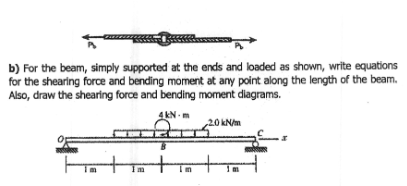
(a) In the given figure, a 20 mm diameter rivet joins plates each 110 mm wide. The allowable stresses are 120 MPa (bearing) and 60 MPa (shear of rivet). Determine (a) Minimum thickness of each plate (b) Maximum average tensile stress in plates
(10 + 10 = 20 Marks)
Question 6
(a) Some engine experts believe that two-stroke petrol engines are noisy, inefficient, and dying technology. Do you agree? Give reasons.
(b) Describe casting and forging processes.
(c) Explain the Carnot cycle in detail. (10 + 5 + 5 = 20 Marks)
Question 7
(a) Write detailed notes on: (i) Diffusion in ceramics (ii) Creep resistant materials
(b) Young’s moduli of alkali metals are:
U (11.5), Na (9.0), K (3.5), Rb (2.7), Cs (1.8), Fr (1.7) GN/m²
Compare this trend with melting points and give reasons.
(10 + 10 = 20 Marks)
Question 8
(a) Differentiate between beams and columns.
(b) What is the role of traffic appraisal in highway administration and scheme preparation?
(c) What are the environmental impacts of water resource projects in Pakistan?
(d) What are different types of pressure measuring devices used in engineering applications?
SUBJECT: Principle of Engineering (Paper-II)
Time Allowed: 3 Hours Maximum Marks: 100
Attempt any FIVE questions in all, including Question No. 8 which is compulsory. Calculator is allowed (non-programmable).
Question 1
An electronics company is considering two options: (a) immediately proceeding with the production of an innovative product which has just completed prototype testing, or (b) first conducting a value analysis study.
If the company proceeds with option (a), it expects with a probability of 0.6 that sales would be 66,000 units at $556 each, and with a probability of 0.4 that sales may remain at 75,000 units at $550 each.
If the company pursues option (b), it expects with a probability of 0.7 that sales would be 75,000 units at $750 each, and with a probability of 0.3 that sales may remain at 70,000 units at $750 each. The value analysis study has a cost of $150,000 and is only applicable under option (b). No additional cost is involved in option (a) as the product is ready to be launched.
Using decision tree analysis, recommend which option should be selected by the company.
Question 2
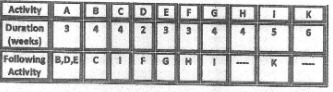
(a) A project with given activities was started on 20/11/2022. If the project is delayed by 2 weeks after completing 6 working weeks, determine the new delivery date of the project.
(b) Explain what is meant by Project Integration Management. Also describe in detail the processes involved in Project Integration Management.
Question 3
Write a short note on the benefits of International Quality Management Systems such as ISO standards.
(b)Also explain what is meant by Cost of Quality and describe its various categories.
Question 4
(a) Classify the software testing techniques commonly used in practice. Explain the testing spectrum, specifying who performs each type of testing along with its general scope.
(b) Describe and then differentiate between static testing and structural (white-box) testing techniques in detail. (10 + 10 = 20 Marks)
Question 5
(a) In the context of independent demand models, what is the difference between the fixed period (P) system and the fixed quantity (Q) system?
(b) A hotel distributes a mean of 1,000 bath towels per day to guests in their rooms. The demand is normally distributed with a standard deviation of 100 towels per day. Based on occupancy, the laundry firm that has the contract supplies these towels to the hotel and requires a two-day lead time. The hotel targets a 98% service level to satisfy customer guests’ expectations.
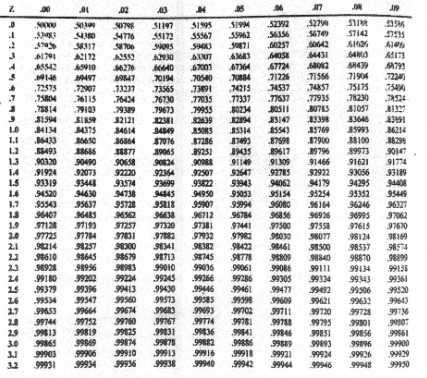
(i) Calculate the safety stock. (ii) What is the reorder point (ROP)? (iii) To what extent (in percentage) would the hotel need to vary its safety stock compared to that calculated in part (i) if the policy changes to a 90% service level? (Table for areas under the normal curve is provided.)
Question 6
(a) What is a Flexible Manufacturing System (FMS)? Write a short note on the various benefits associated with an FMS if it is implemented successfully in an organization.
(b) What is Agile Manufacturing? Provide an overview of the concept and some possible approaches as to how this may facilitate your organization.
Question 7
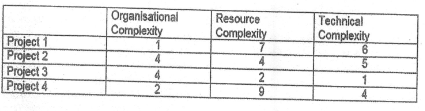
An organization has done some estimation of the complexity of four of its current projects and has ranked them out of 10 against the headings shown in the following table:
In the absence of any further information, if the organization wanted to apply the PRINCE2 methodology to only one of the projects, which one would you recommend? (20 Marks)
Q.No.8 Choose the best option (Compulsory) (20 Marks)
Keeping in view the feasibility, order of magnitude, the preliminary conceptual or budget estimates are prepared by:
(A) Architect/Engineer (B) Construction manager (C) Client himself/herself (D) Construction manager
Which statement is correct?
(A) Ratio analysis is the procedure of determining and interpreting numerical relationship of various items of the financial statement. (B) All financial ratios are obtained by relating two sets of information contained in a single financial statement. (C) The relationship between two accounting figures expressed mathematically is known as ______.