PUNJAB PUBLIC SERVICE COMMISSION Combined Competitive Examination (CCE) 2020 For Recruitment to the Posts of Provincial Management Service (PMS)
SUBJECT: Principle of Engineering (Paper-1) Time Allowed: 3 Hours Maximum Marks: 100
Note: Attempt any FIVE questions in all. Scientific calculator is allowed.
Instructions:
Attempt any FIVE questions in all, including Question No. 8 (Compulsory).
All parts of a question must be attempted at one place.
Write Q. No. clearly.
Do not leave blank spaces between answers.
Use of calculator (non-programmable) is allowed.
Q.1 a) Explain in detail the two postulates of Special Theory of Relativity. Also explain:
Time Dilation
Length Contraction
b) Explain superconductivity in detail. Also explain:
Meissner Effect
Applications of superconductivity
Differentiate between Reflection and Refraction. (10 + 10 = 20 Marks)
Q.2 a) Explain hydrogen bonding in water and ice. Discuss its importance in ecosystem and textile materials.
b) Calculate the mole fraction of benzene (C₆H₆) in a solution containing 40% by mass in carbon tetrachloride (CCl₄). (10 + 10 = 20 Marks)
Q.3 a) Differentiate between mutual and self-inductance. Explain magnetic hysteresis and total internal reflection with applications.
b) Discuss principle, construction, and components of motors that can also be used as generators. (10 + 10 = 20 Marks)
Q.4 a) Differentiate between 2-stroke and 4-stroke diesel engines. Also list advantages of modern diesel engines not operating on diesel cycle.
b) A two-cylinder, four-stroke petrol engine has:
Bore = 380 mm
Stroke = 585 mm
Speed = 240 RPM
Torque = 11.86 kN·m
Calculate: (i) Brake Power (ii) Brake Mean Effective Pressure (10 + 10 = 20 Marks)
Q.5 Explain composition, characteristics, and uses of: i) Low-carbon steel ii) Medium-carbon steel iii) High-carbon steel iv) White iron v) High-speed steel (5 × 4 = 20 Marks)
Q.6 a) Write a note on low-cost roads and low-cost housing techniques recommended in developing countries.
b) Describe various filtration techniques used for water treatment. (10 + 10 = 20 Marks)
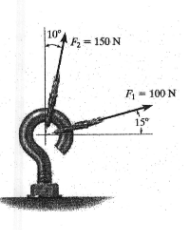
Q.7 A hook is subjected to two forces:
F₁ = 100 N
F₂ = 150 N
Determine the magnitude and direction of the resultant force. (20 Marks)
Q.8 (Compulsory)
Write short notes with labeled diagrams on: i) Machining ii) Punching iii) Shearing iv) Stamping v) Casting (5 × 4 = 20 Marks)
SUBJECT: Principle of Engineering (Paper-II)
Time Allowed: 3 Hours Maximum Marks: 100
Instructions:
Attempt any FIVE questions, including Q.8 (Compulsory).
Q.1 a) Explain steps through which an operations manager enhances manufacturing and services.
b) What is the mission of Production and Operations Management Society (POMS)? How do global chapters help professionals? (10 + 10 = 20 Marks)
Q.2 a) Describe key engineering management tools used in Pakistan.
b) Explain importance of employee engagement and customer relationship. (10 + 10 = 20 Marks)
Q.3 a) How does Decision Support System improve HR problem solving?
b) Explain decision tree with flow chart for problem analysis. (10 + 10 = 20 Marks)
Q.4 a) Differentiate CPM and PERT in project scheduling.
b) Explain role of mathematical modeling in process optimization. (10 + 10 = 20 Marks)
Q.5 a) A company borrows $20,000 at 9% interest for 5 years with $200 fee. Draw cash flow diagrams for:
Equal yearly payments
Single payment at end
Suggest better plan.
b) How can MS Excel be used to find present worth for gradient series? (10 + 10 = 20 Marks)
Q.6 a) Calculate inflation rates from data:
Year 0 → 504,000 Year 1 → 538,400 Year 2 → 577,004 Year 3 → 629,500
Find average inflation rate.
b) Explain role of ISO in sustainable quality management. (10 + 10 = 20 Marks)
Q.7 a) Differentiate FIFO and LIFO inventory systems.
b) Perform CPM analysis for the following:
Activity Duration Precedence
Activity Duration Precedence
A 2 –
B 7 A
C 10 A
D 4 –
E 6 B
F 5 B, C
G 8 C, D
H 9 D
I 12 F, G
J 5 F
K 5 E, J
L 6 G, H
M 4 F, H
N 3 I, K, L, M
(10 + 10 = 20 Marks)
Q.8 (Compulsory – MCQs)
Organizations analyze decisions using:
a) Cost-benefit
b) Benefit-cost
c) Both
d) All
Software testing can be:
a) Black box
b) White box
c) Both
d) None
Testability refers to:
a) Ability to test experiment
b) Hypothesis testing
c) Theory testing
d) All
FEM stands for:
a) Finite Element Method
b) Finite Environment Method
c) Finite Energy Method
d) None
Regression analysis can be done in:
a) ANOVA
b) SPSS
c) Excel
d) All
Gantt charts are developed in:
a) MS Project
b) Primavera
c) Both
d) None
Macroeconomics deals with:
a) Interest rate
b) Productivity
c) Large-scale factors
d) All
Price determination model:
a) Supply & Demand
b) Supply only
c) Demand only
d) None
Limited competition market:
a) Oligopoly
b) Monopoly
c) Pligopoly
d) None
PDCA cycle:
a) Plan Do Check Act
b) Plan Do Check Acquire
c) Plan Do Charge Act
d) None
Decision tree internal node:
a) Test
b) Label
c) Cost
d) Duration
Inventory management is part of:
a) Supply chain
b) Materials
c) Products
d) All
Most important resource:
a) Manpower
b) Machinery
c) Money
d) Materials
Inventory management supervises:
a) Assets
b) Stock
c) Inventory
d) All
ISO 14000 relates to:
a) Contracts
b) Environment
c) Sustainability
d) Process
Activity relationship type:
a) Finish-to-Finish
b) Top-to-Top
c) Bottom-to-Bottom
d) All
Direct expense:
a) Carriage inward
b) Carriage outward
c) Carriage forward
d) All
Five E’s of safety:
a) Engineering, Education, Enforcement, Encouragement, Evaluation