PUNJAB PUBLIC SERVICE COMMISSION Combined Competitive Examination (CCE) 2019 For Recruitment to the Posts of Provincial Management Service (PMS)
SUBJECT: Principle of Engineering (Paper-1) Time Allowed: 3 Hours Maximum Marks: 100
Note: Attempt any FIVE questions in all. Scientific calculator is allowed.
Section – A
Q No. 1: a) Explain in detail the Pauli Exclusion Principle and Heisenberg Uncertainty Principle.
b) What is Planck’s Constant? Explain its significance. Discuss Wave-Particle Duality and its practical applications (e.g., Electron Microscope). (10+10 Marks)
Q No. 2: a) Differentiate between Ideal and Non-ideal solutions. State and explain Boyle’s Law and Charles’s Law with graphical representations.
Shutterstock b) Numerical: Calculate the Molarity of a solution having 60 g of Co(NO3)2⋅6H2O in 4.3 L of solution. (10+10 Marks)
Q No. 3: a) Compare Induction Motors and Synchronous Motors. Write down their Speed and Torque relations. b) Numerical: A 24 V permanent magnet DC motor has a coil resistance of 2 Ω. It develops a back emf of 22.5 V at normal speed. Find the current: (i) At startup. (ii) When running at normal speed. (10+10 Marks)
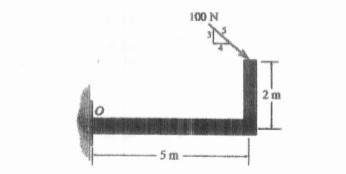
Q No. 4: Statics: Determine the moment of a 100 N force about point O as shown in the figure below.
(Refer to your original Fig. 1 for dimensions: 2m height, 5m base) (20 Marks)
Section – B
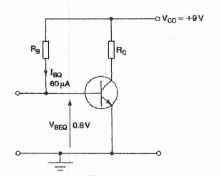
(Electronics & Mechanical) Q No. 5: a) Discuss the working and classification of Amplifiers. What are RC Oscillators? List their applications in electronics. b) Numerical: For the biased transistor circuit (Fig. 2), given VCC=+9 V, IB=60 μA, and VBE=0.8 V. Determine the suitable value for the base resistor RB. (10+10 Marks)
Q No. 6: a) State the 2nd Law of Thermodynamics. Describe the structural and operational differences between 2-stroke and 4-stroke engines.
Shutterstock b) Numerical: A 4-stroke single-cylinder engine has a diameter (d) of 50.8 mm and stroke length (L) of 76.2 mm. (i) Find the Swept Volume (Vs) in cc. (ii) If Clearance Volume (Vc) is 20 cm3, find the Compression Ratio (r). (10+10 Marks)
Section – C
(Civil & Management) Q No. 7: a) Write a detailed note on Amorphous Materials. Explain the different types of Metallic Crystal Structures (BCC, FCC, HCP) found in solids.
b) Compare Impulse Water Turbines and Reaction Water Turbines. Discuss their advantages, disadvantages, and engineering applications. (10+10 Marks)
Q No. 8 (Compulsory): a) Discuss the Environmental Impact Assessment (EIA) for large-scale water resource projects (Dams/Canals). b) Explain the use of Ceramic Materials in engineering. Discuss their mechanical and thermal properties in industrial applications. (10+10 Marks)
Section – D
(Engineering Economics & Management) Q No. 9: a) Define the following terms:
Net Present Value (NPV) Salvage Value Opportunity Cost Internal Rate of Return (IRR) b) Explain the Benefit-Cost Ratio (B/C) and Break-even Analysis for a project. Getty Images Explore (10+10 Marks)
Q No. 10: a) Define Economic Order Quantity (EOQ). Sketch the EOQ model and derive its basic formula.
b) Numerical: A company requires 12,000 units annually. Unit price = Rs. 1,200. Order cost = Rs. 3,000. Carrying cost = 24% per annum. A 2% discount is available for lots >1,000. Determine the most economical lot size. (20 Marks)
SUBJECT: Principle of Engineering (Paper-II)
Time Allowed: 3 Hours Maximum Marks: 100
Instructions: Attempt any FIVE questions in all, including Question No. 8 (Compulsory). All questions carry equal marks. Use of calculator is allowed.
Q.1 Define and explain the following: a) Net Present Value b) Book Value and Salvage Value c) Fixed and Variable Costs d) Internal Rate of Return (IRR) e) Opportunity Cost
Also explain Benefit-Cost (B/C) Ratio and Break-Even Point for a project. (10 + 10 = 20 Marks)
Q.2 a) What are predecessor and successor activities? Also define earliest time, latest time, and slack time.
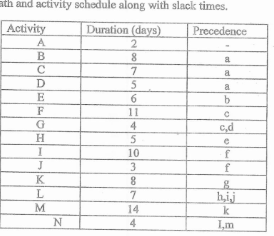
b) The activity chart for a plant repair project along with precedence and estimated activity times is given below. Develop a PERT network, determine the critical path, and activity schedule along with slack times.
Q.3 a) Define, sketch, and explain Economic Order Quantity (EOQ). Also develop the basic EOQ formula.
b) A home appliance manufacturing company has an annual requirement of 12,000 thermostats. The unit price is Rs. 1200. If the order quantity exceeds 1000 units, a discount of 2% is available. Ordering cost is Rs. 3000 per order and holding cost is 24% per annum. Determine the lot size for minimum total cost. (10 + 10 = 20 Marks)
Q.4 a) Define and explain prevention, appraisal, internal failure, and external failure costs.
b) List quality management ideas of Deming, Juran, and Crosby. How can these ideas help in building a quality management system?
(10 + 10 = 20 Marks)
Q.5 a) Explain Job Production, Batch Production, Continuous Production, Mass Production, and Group Technology.
b) Elaborate Just-in-Time (JIT) production system, clearly stating its constraints and benefits.
(10 + 10 = 20 Marks)
Q.6 a) Define and explain Maximax and Maximin decision-making under uncertainty.
b) Elaborate the following:
Cause-and-Effect Diagram Pareto Diagram Control Chart Process Capability Scatter Diagram (10 + 10 = 20 Marks)
Q.7 a) Compare authoritarian, supportive, consultative, and Japanese styles of management.
b) What are the basic principles of production management to improve product, process, and plant along with efficient human resource utilization?
(10 + 10 = 20 Marks)
Q.8 (Compulsory) Choose the correct answer and mark it with a tick. (20 Marks)
Current Assets – Current Liabilities = a) Working Capital b) Current Value of the Firm c) Share Value Index d) Turnover A machine costing Rs. 8500 has a scrap value of Rs. 300 and a life of 25,000 hours. If used for 1500 hours in the first year, depreciation will be: a) Rs. 492.00 b) Rs. 542.00 c) Rs. 548.50 d) Rs. 692.00 Jobs going behind schedule are conveniently shown in: a) Milestone Chart b) PERT Chart c) Bar Chart d) Gantt Chart An organization may decide to buy a component from outside when: a) Production facilities are limited b) Need to maintain employment stability c) Cost of buying is less than production d) All of the above Choose the correct statement: a) CPM and PERT are event-oriented techniques b) CPM and PERT are activity-oriented techniques c) CPM is activity-oriented while PERT is event-oriented d) None of the above Which of the following is not a management thinker? a) Taylor b) Galileo c) Drucker d) McGregor A military organization is known as: a) Committee Organization b) Line Organization c) Line and Staff Organization d) Functional Organization Machine loading means: a) Load of machine + heaviest job b) Same as (a) c) Electrical load of motors d) Amount of work assigned to a machine Advertisement cost is included in: a) Fixed Cost b) Sometimes fixed, sometimes variable c) Always variable d) Never included Which of the following is not wealth? a) Office Building b) Goodwill c) Services of a Consultant d) Water in Sea Control limits are: a) Defined by customers b) Natural variability limits c) Inherent variability limits d) Statistical limits Which is not a component of quality? a) Reliability b) Durability c) Acceptance Sampling d) Serviceability How many points did Deming give? a) 23 b) 14 c) 12 d) 10 In 3σ quality performance, probability of conforming product is: a) 1.0000 b) 0.9973 c) 0.9500 d) 0.9467 Probability distribution relates a variable to: a) Probability of occurrence b) Other probabilities c) Frequency d) Random variable An uncertain event affecting objectives is called: a) Random Chance b) Uncertainty c) Risk d) Hazard Document listing all risks is called: a) Management Reserves b) Contingency Reserves c) Change Control d) Risk Register Assessment of internal and external environment is: a) SWOT Analysis b) Competitive Analysis c) Industry Analysis d) Market Analysis In work study, symbol “D” means: a) Delay b) Transport c) Operation d) Inspection Product layout is suitable for: a) Jobbing Work b) Batch Production c) Continuous Production d) Efficient Machine Utilization