Federal Public Service Commission (FPSC) Competitive Examination for Recruitment to BPS-17 Posts under the Federal Government
Paper: Physics
Time Allowed: 3 Hours
PAPER-I (Subjective) 80 Marks
PART-II
Attempt ONLY FOUR questions from PART-II, ALL Questions carry EQUAL marks.
Q. No. 2.
(a) Show that the work daone by a constant force is equal to the difference of initial and final kinetic energies of the body.
(b) A 25 kg bear slides from rest, 12 m down a pine tree, moving with a speed of 5.6 m/s just before hitting the ground. (i) What change occurs in the gravitational potential energy of the bear-Earth system during the slide? (ii) What is the kinetic energy of the bear just before hitting the ground?
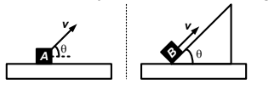
(c) Object A is launched as a projectile with initial speed v at an angle θ above the horizontal. Object B has exactly the same initial speed and angle as Object A but slides up a frictionless incline. Object A has mass M and Object B has mass 2M. During the subsequent motion, each object will reach a maximum height above the starting location.
(i) At its maximum height, which object has the larger kinetic energy? Explain. (ii) Which object has the larger maximum height? Explain.
Q. No. 3.
(a) Derive the expression for the total mechanical energy in simple harmonic motion. Draw and discuss the graphs of Energy versus Time and Energy versus Position.
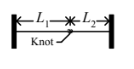
(b) Two strings are tied together with a knot and stretched between two rigid supports. Their linear densities are μ₁ = 1.4 × 10⁻⁴ kg/m and μ₂ = 2.8 × 10⁻⁴ kg/m. Their lengths are L₁ = 3 m and L₂ = 2 m. String 1 is under a tension of 400 N. Simultaneously, a pulse is sent along each string toward the knot. Which pulse reaches the knot first?
(c) A mass-spring system is oscillating with amplitude A. At what displacement is the kinetic energy equal to the potential energy?
Q. No. 4.
(a) What is polarization? Discuss polarization by reflection.
(b) Light of wavelength 624 nm is incident normally on a soap film (n = 1.33) suspended in air. (i) Find the least thickness. (ii) Find the second least thickness for which reflected light undergoes constructive interference.
(c) A maintenance crew is working on a section of a three-lane highway, leaving only one lane open to traffic. Do cars on the highway behave like: (i) Molecules of an incompressible fluid? (ii) Molecules of a compressible fluid? Explain.
Q. No. 5.
(a) Show that mass and energy are interconvertible.
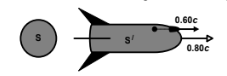
(b) A spaceship is moving away from the Earth at a speed of 0.80c when it fires a missile in the same direction. The missile moves at 0.60c relative to the spaceship. Find the speed of the missile as measured by an observer on Earth. Compare it with Galilean kinematics.
(c) If A and B are non-zero vectors, is it possible for both A·B and A×B to be zero? Explain.
Q. No. 6.
(a) Distinguish between linear and angular momentum. Derive the expression for angular momentum of a rigid body rotating about a fixed axis. Explain the law of conservation of angular momentum.
(b) A girl of mass M stands on the rim of a frictionless merry-go-round of radius R and rotational inertia I. She throws a rock of mass m tangentially with speed v relative to the ground. (i) Find the angular speed of the merry-go-round. (ii) Find the linear speed of the girl.
(c) A planet moves at constant speed in a circular orbit around a star. What is the net work done by the star’s gravitational force in one complete orbit? What if the orbit is elliptical? Explain.
Q. No. 7.
(a) Differentiate between Fermi-Dirac, Bose-Einstein and Maxwell-Boltzmann statistics.
(b) Show that entropy remains constant in a reversible process but increases in an irreversible process.
(c) When 20.9 J of heat is added to an ideal gas, its volume changes from 50 cm³ to 100 cm³ at constant pressure of 1 atm. (i) Find the change in internal energy. (ii) If the amount of gas is 2 × 10⁻³ mol, find Cp.
Q. No. 8.
Explain any FOUR of the following:
(a) Scalar Triple Product (b) Surface Tension (c) He-Ne Gas LASER (d) Gravitational Potential Energy
PAPER-II (Subjective) 80 Marks
PART-II
Attempt ONLY FOUR questions from PART-II, ALL Questions carry EQUAL marks.
Q. No. 2.
(a) Define and explain Gauss’ Law. Deduce Coulomb’s Law from Gauss’ Law. (8)
(b) Find the Electric Field Intensity due to an infinite sheet of charge. (8)
(c) The electric field near an infinite sheet of charge is 3.84 × 10⁵ N/C. What is the surface charge density on the sheet? (ε₀ = 8.85 × 10⁻¹² C²/N·m²) (4)
Q. No. 3.
(a) Derive an expression for capacitance of cylindrical and spherical capacitor. (8)
(b) Show that the energy consumed in charging a capacitor to charge Q and voltage V can be considered as potential energy stored in the field between the plates. Find expression for energy stored in the field. (8)
(c) An isolated conducting sphere whose radius R is 6.85 cm has a charge q = 1.25 nC. How much potential energy is stored in the electric field of this charged conductor? (ε₀ = 8.85 × 10⁻¹² C²/N·m²) (4)
Q. No. 4.
(a) Derive an expression for the time-dependent Schrödinger Wave Equation. (8)
(b) Explain de Broglie’s hypothesis of matter wave. (8)
(c) Determine the de Broglie wavelength of an electron that has been accelerated through a potential difference of 100 V. (h = 6.63 × 10⁻³⁴ J·s) (4)
Q. No. 5.
(a) What is a Transistor? Briefly explain three types of Transistor Circuit Configurations. (8)
(b) Draw a neat diagram of Transistor Characteristics in Common Emitter Configuration for P-N-P and N-P-N transistor. Also discuss types of characteristic curves for a transistor in Common Emitter Configuration. (8)
(c) Write a short note on Load Line. (4)
Q. No. 6.
(a) What do you understand by nuclear fission? How was it explained theoretically on the basis of the liquid drop model? (8)
(b) Briefly describe important uses of radioisotopes. (8)
(c) A 5.30 MeV alpha particle happens, by chance, to be headed directly towards the nucleus of an atom of gold, which contains 79 protons. How close does the alpha particle get to the centre of the nucleus before coming momentarily to rest and reversing from the relatively massive nucleus? (4)
Q. No. 7.
(a) Explain the construction and working of a Geiger-Müller Counter. (8)
(b) Draw the characteristics of a Geiger-Müller Counter and also explain them. (8)
(c) What are the properties of Gamma Rays? (4)
Q. No. 8.
Write short notes on any TWO of the following: (10 each)