Federal Public Service Commission (FPSC) Competitive Examination for Recruitment to BPS-17 Posts under the Federal Government
Paper: Physics
Time Allowed: 3 Hours
PAPER-I (Subjective) 80 Marks
PART-II
Attempt ONLY FOUR questions from PART-II, ALL Questions carry EQUAL marks.
Q. No. 2. (20)
(a) How does a vector quantity differ from a scalar quantity? (06)
(b) A small airplane leaves an airport on an overcast day and is later sighted 215 km away in a direction making an angle of 22° east of north. How far east and north is the airplane from the airport when sighted? (08)
(c) Explain the conservation of linear momentum and angular momentum. (06)
Q. No. 3. (20)
(a) Describe the Michelson–Morley experiment and show how the negative results obtained from this experiment were interpreted. (10)
(b) What is time dilation in Special Theory of Relativity? Obtain an expression for time dilation regarding the time interval between two events measured from two different inertial frames. (10)
Q. No. 4. (20)
(a) What is length contraction in Special Theory of Relativity? (04)
(b) What are Isothermal and Adiabatic changes? Explain with a Pressure–Volume (P–V) diagram. (08)
(c) Define the term Coherence. Derive an expression for the coherence length of a wave train that has a frequency bandwidth Δν. (08)
Q. No. 5. (20)
(a) Explain the formation of Newton’s Rings and show that the radius of the mᵗʰ dark ring is proportional to the square root of the wavelength. (10)
(b) What is a diffraction grating? Define grating element. Explain how a plane transmission grating is used to determine the wavelength of light. (10)
Q. No. 6. (20)
(a) What is a LASER? Explain, with a neat diagram, the processes of absorption of light, spontaneous emission, and stimulated emission of light. (08)
(b) Explain, with the help of an energy-level diagram, how stimulated emission results from electron impact in a He–Ne Gas LASER. (06)
(c) Explain how the viscosity of a given liquid is determined experimentally using Stoke’s Method. (06)
Q. No. 7. (20)
(a) Distinguish between the resolving power and magnifying power of a telescope. (08)
(b) Discuss the applications of the First Law of Thermodynamics. (06)
(c) Describe Galileo’s Principle of Relativity. (06)
Q. No. 8. (20)
Briefly discuss ANY FOUR of the following: (05 each)
(a) Standing Waves
(b) Doppler Effect
(c) Electromagnetic Waves
(d) Surface Tension
(e) Components of Vectors
PAPER-II(Subjective) 80 Marks
PART-II
Attempt ONLY FOUR questions from PART-II, ALL Questions carry EQUAL marks.
Q. No. 2. (20)
(a) State and prove Gauss’s Law of Electrostatics. Derive its differential form. (12)
(b) Use Gauss’s Law to calculate the electric field due to a line charge. (05)
(c) A point charge is at the centre of a cubical Gaussian surface. What is the net electric flux through this surface? Use Gauss’s Law. (03)
Q. No. 3. (20)
(a) Analyze the RLC series circuit using the j-operator method and discuss its frequency response. Discuss the importance of this circuit. (14)
(b) Find the impedance of a circuit consisting of a resistor, capacitor, and inductor connected in series at a given frequency. (04)
(c) What are the advantages of AC mains supply? (02)
Q. No. 4. (20)
(a) Describe the forward and reverse biased characteristics of a PN junction. (06)
(b) Explain the working of a bridge rectifier using a neat and labelled circuit diagram. (12)
(c) Why are semiconductor devices preferred over vacuum tubes? (02)
Q. No. 5. (20)
(a) What is meant by the Compton Effect? Derive an expression for the Compton shift in wavelength. (16)
(b) A beam of X-rays is scattered by a carbon target. At a given angle from the beam direction, the scattered X-rays have a specified wavelength. Determine the wavelength of the X-rays in the direct beam. (04)
Q. No. 6. (20)
(a) Derive expressions for the half-life and mean life of a radioactive substance. (15)
(b) The activity of a certain radionuclide decreases to 15% of its original value in 10 days. Find its half-life. (03)
(c) Give any two industrial or medical uses of radioisotopes. (02)
Q. No. 7. (20)
(a) Differentiate between Nuclear Fission and Nuclear Fusion. (03)
(b) Draw a labelled diagram of a nuclear reactor and explain the functions of its various parts. (13)
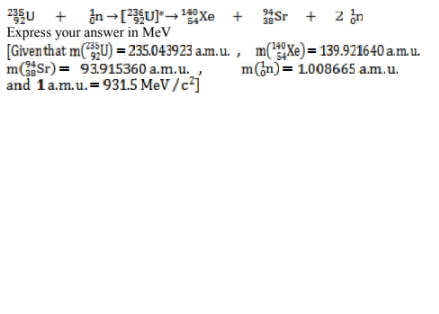
(c) Calculate the energy released in the given fission reaction induced by slow neutrons.
Q. No. 8. (20)
Write notes on ANY TWO of the following: (10 each)