Federal Public Service Commission (FPSC) Competitive Examination for Recruitment to BPS-17 Posts under the Federal Government
Paper: Physics
Time Allowed: 3 Hours
PAPER-I (Subjective) 80 Marks
PART-II
Attempt ONLY FOUR questions from PART-II, ALL Questions carry EQUAL marks.
Q. No. 2. (a) A vector is given by R = 2i + j + 3k. Find: (i) The magnitude of the x, y and z components. (ii) The magnitude of R. (iii) The angle between R and the x, y and z axes. (3,3,3)
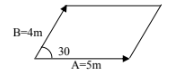
(b) Vectors A and B have equal magnitudes of 5.0. If the sum of A and B is the vector 6j, find the angle between A and B. (6)
(c) Find the area of the parallelogram formed by vectors A and B.
Q.3. (a) State Hooke’s Law. A mass attached to an elastic spring is displaced from its equilibrium position and released. Show that its motion is simple harmonic and derive the differential equation, relations for instantaneous velocity, displacement and acceleration. Also plot each quantity with time for such motion. (1,1,2,3,3)
(b) A block of unknown mass is attached to an elastic spring having spring constant 6.5 N/m and undergoes simple harmonic motion with an amplitude of 10 cm. When the block is halfway between its equilibrium position and the end point, its speed is 30 cm/s. Find: (i) Mass of the block. (ii) Time period of the system. (iii) Maximum acceleration of the block. (2,3,3)
(c) A mass-spring system is in an elevator which moves upward with an acceleration “a”. What will be the effect on the measured value of spring constant compared to its value when the elevator is at rest? (2)
Q.4. (a) What are conservative and non-conservative forces? Give two examples of each. Prove mathematically that the work done around a closed path in a conservative field is zero. (2,2,6)
(b) A force acting on a particle moving in the XY-plane is given by:
F = (2y i + x² j) N
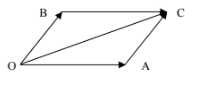
where x and y are in meters. The particle moves from the origin to a final position having coordinates x = 5.0 m and y = 5.0 m as shown in the figure. Calculate the work done by the force F along:
(i) Path OAC (ii) Path OBC (iii) Path OC (iv) Is force F conservative? (2,2,2,2)
(c) Name the various forces of nature. (2)
Q.5. (a) Differentiate between laminar and turbulent flow. Derive Bernoulli’s equation for an incompressible and non-viscous fluid flowing through a non-uniform pipe and show that the sum of pressure, kinetic energy per unit mass and potential energy per unit mass at one point is equal to the sum of these quantities at another point with different cross-sectional area. (2,5,3)
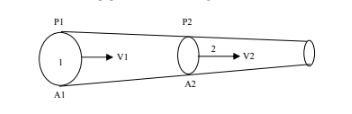
(b) A horizontal constricted pipe, as shown below, is called a Venturi Tube and can be used to measure the flow speed of an incompressible fluid.
Derive the relation for the flow speed at point (2) if the pressure difference (P₁ − P₂) is known. (8)
(c) Why is the speed of water in the middle of a smoothly flowing stream higher than its speed near the sides? (2)
Q.6. (a) What is Moment of Inertia? A rigid body of mass M is rotating with angular velocity ω. Derive the relation for rotational kinetic energy of the body in terms of moment of inertia. (2,8)
(b) Prove that the moment of inertia of a uniform rod of length L and mass M about an axis passing through its centre is:
I = ML²/12 (8)
(c) Differentiate between the kinetic energy of a bullet fired by a gun and that of a rifle bullet when both have the same linear velocity. (2)
Q.7. (a) Differentiate between the Special Theory and the General Theory of Relativity. Write the basic postulates of the Special Theory of Relativity. (2,4)
(b) An event occurs at a point (x, y, z) at time t in a frame of reference S. Using Lorentz Transformation, derive the coordinates (x′, y′, z′) and t′ of the event as observed in a frame S′ moving relative to S with a constant speed U in the positive x-direction. (10)
(c) Differentiate between inertial and non-inertial frames of reference. (4)
Q.8. Write short notes on ANY TWO of the following:
(a) Interference of Light and Young’s Double Slit Experiment. (b) LASER, its production and applications. (c) Second Law of Thermodynamics and its applications.
PAPER-II (Subjective) 80 Marks
PART-II
Attempt ONLY FOUR questions from PART-II, ALL Questions carry EQUAL marks.
Q. No. 2.(a) Charge is uniformly distributed on a line with charge density λ. Calculate the electric field intensity at a point lying vertically at a distance y from the center of the charge distribution. (10)
(b) In a uniform electric field near the surface of the Earth, a particle having charge q = –3 × 10⁻⁹ C is acted upon by a force 5 × 10⁻⁶ N. Find: (i) The magnitude of the electric field. (ii) The magnitude and direction of the electric force on an electron placed in this field. (iii) The ratio of electric force to gravitational force in this case. (3,3,3)
(c) What is meant by a point charge? (1)
Q.3. (a) State Faraday’s Law of Electromagnetic Induction. Using this law, find the inductance due to a current-carrying coil in the specific case of a solenoid. (10)
(b) A solenoid 126 cm long is formed from 1870 windings carrying a current of 4.36 A. The core of the solenoid is filled with iron and the effective permeability constant is 968. Calculate the inductance of the solenoid, assuming that it can be treated as ideal with a diameter of 4.45 cm. (8)
(c) Write the importance of Faraday’s Law in today’s perspective. (2)
Q.4. (a) What is Modern Physics? Give the failure of Classical Physics in explaining the Photoelectric Effect. Derive the photoelectric equation and comment on how Quantum Physics successfully explained the photoelectric effect. Also sketch the photoelectric equation. (3,3,5,3)
(b) A beam of radiation with frequency 3.19 × 10¹⁵ Hz is incident on a metal surface and knocks out electrons from it. If the work function of the metal is 2.33 eV, find the maximum kinetic energy of the emitted electrons in electron volts. (5)
(c) What is the difference between ionization energy and work function? (2)
Q.5. (a) Differentiate between metals, semiconductors and insulators on the basis of Energy Band Theory. (6)
(b) What is a PN junction? How is it formed and why is it called a diode? (6)
(c) What is a rectifier? How can a diode be used as a rectifier? Explain half-wave and full-wave rectification in detail. (8)
Q.6. (a) Explain how Davisson and Germer experimentally proved that a material particle like an accelerated electron can act as a wave. (10)
(b) Calculate the de Broglie wavelength of an electron accelerated through a potential difference of 100 kV. Should relativistic correction be applied in this calculation? (8)
(c) Sketch the probability distribution of an electron in the hydrogen atom. (2)
Q.7. (a) What is radioactivity? What changes occur in a radioactive nucleus when α, β and γ radiations are emitted? How can these radiations be differentiated experimentally? (10)
(b) Define the half-life of a radioactive element. Describe the law of radioactive decay and sketch a graph between half-life and activity of a radionuclide. (8)
(c) Is the proton an elementary particle? Comment. (2)
Q.8. (a) Define Nuclear Fission and Nuclear Fusion reactions. What is the source of energy released in these reactions? Justify your answer with examples. Explain the Fission Chain Reaction. (10)
(b) A ⁷Li₃ nucleus is bombarded by a proton. Two alpha particles (⁴He₂) are produced. Find the reaction energy.
Given: Mass of proton = 1.007825 amu Mass of ⁷Li₃ = 7.016003 amu Mass of alpha particle = 4.002603 amu (8)



 ×
×